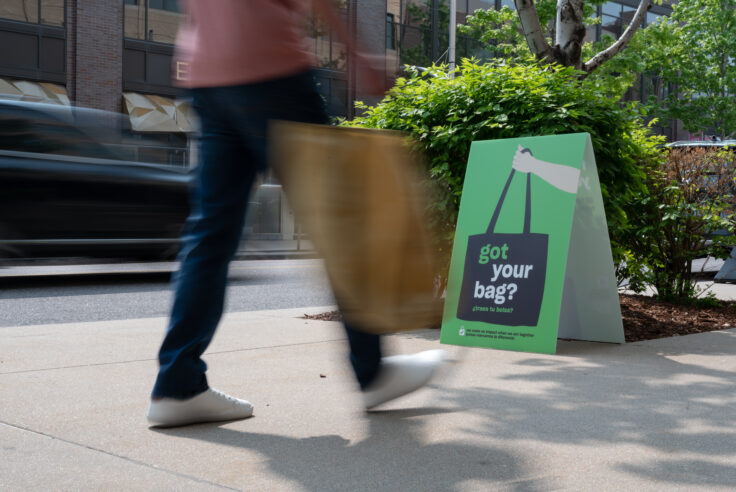
Scaling city-wide behavior change across cities

What drives consumers to adopt new behaviors and stick with them? Based on nearly a decade of consumer research, in-market testing and large-scale behavior change initiatives, this report explores the conditions that drive participation in circular systems. Drawing on real-world projects across reuse, recycling and waste reduction programs, the report highlights five evidence-based principles for changing behavior at scale.

The findings demonstrate that lasting behavior change is not simply a matter of awareness or motivation. It requires thoughtfully designed systems that manage friction, provide clear guidance, leverage social norms and make participation visible and convenient. For brands, retailers, municipalities and operators, this report offers practical insights for designing consumer experiences that increase engagement, build new habits and accelerate the transition to a circular economy.


220k

reusable purple cups successfully returned

4

citywide consumer behavior change activations to date

9.5M

fewer single-use bags used per year based on pilot results

5

key insights on how to change consumer behavior

Our work has pointed us to a simple but profound truth: behavior change is often framed as a consumer challenge, but it is fundamentally a design challenge.
Kate Daly, Managing Director of Closed Loop Partners' Center for the Circular Economy
Friction can make or break participation

The most successful behavior change programs understand that friction is not inherently good or bad. Instead, they intentionally reduce friction around the desired behavior and, in some cases, introduce modest friction around the behavior they are seeking to change.

The most effective messages require the least explanation

Across our consumer behavior research and in-market campaigns, one lesson consistently emerges across cities: consumers are far more likely to adopt a new behavior when the desired action is simple and easy to understand.

Visible infrastructure and cues at key decision points enable action

Successful programs recognize that behavior change does not happen through messaging alone. Participation increases when consumers encounter visible infrastructure and cues that make the desired behavior easy to notice, understand and act upon.

Social norms outperform environmental appeals

Social norms shape behavior. When consumers see others participating and recognize a behavior as common and expected, they are far more likely to adopt it themselves than when they are motivated by environmental messaging alone.

Incentives can spark participation, but convenience sustains it

Across our citywide initiatives, incentives have proven most effective when they are part of a broader behavior change strategy that combines convenience, visibility, social norms and clear guidance.

Download Report

Related Content

Ready to solve your most pressing material challenges?
Let’s connect.

Your name
Email Address
Your message
Thank you! Your submission has been received!
Oops! Something went wrong while submitting the form.