
.svg)

Closed Loop Partners Releases New Report Unveiling a Proven Framework for Driving Consumer Behavior Change in Reuse and Waste Reduction in the U.S.
Drawing on nearly a decade of real-world testing across cities, retail environments and consumer-facing initiatives, Closed Loop Partners reveals how organizations can accelerate adoption of circular solutions through integrated system design.
New York, NY, August 11 – Closed Loop Partners' innovation center, the Closed Loop Center for the Circular Economy (the Closed Loop Center) today released a new report, Scaling Citywide Behavior: Lessons in Consumer Behavior Design from Closed Loop Partners' Reuse and Waste Reduction Campaigns, sharing a practical framework to help brands, retailers, cities and others increase participation in reuse, recycling and waste reduction across the U.S.
As Extended Producer Responsibility (EPR) policies expand across the country and global brands and cities invest in new circular economy infrastructure, one factor consistently determines the success of circular systems: participation. Even the most well-designed systems depend on consistent consumer engagement to drive long-term impact.
Over the last decade, the Closed Loop Center has successfully shifted consumer behavior at scale through some of the largest citywide activations in North America, working alongside leading brands, retailers, municipalities, community groups and foodservice operators to test and refine circular solutions in real-world settings.
Informed by nearly a decade of testing consumer-facing interventions across the U.S., the new report outlines the strategies and tactics that have led to higher participation in reuse, recycling and waste reduction programs through five key drivers: friction management, simple messaging, visible infrastructure and cues, social norms and incentives. Further, it demonstrates how these factors work together within a broader system to influence behavior, offering organizations a practical methodology for designing programs that achieve measurable adoption and long-term engagement at city scale.
“Adoption of new consumption habits is often framed as something wholly dependent on consumers changing their behavior,” said Kate Daly, Managing Partner at Closed Loop Partners and Head of the Closed Loop Center for the Circular Economy. “Our findings point to a different path that can drive change much faster: design. We've seen that when systems are designed to be visible and convenient and environments are optimized to shift the community norm, participation becomes the easy choice and circular systems can begin to scale.”
Drawing on in-market activations across the U.S.—from California and Arizona to Virginia and New Jersey and beyond—the report shows why cities are a critical proving ground for behavior change: they bring together residents, businesses and infrastructure in real-world settings where reuse, refill, recycling and waste reduction solutions can be tested, measured and adapted to accelerate the circular economy at scale. The report highlights select case studies from the Closed Loop Center’s work, including:
Retail Bag Waste Reduction Campaigns in Denver and Tucson
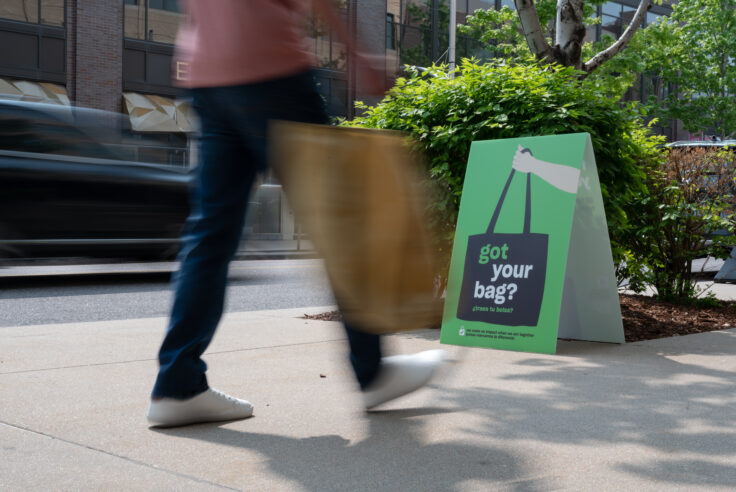
- Led by the Consortium to Reinvent the Retail Bag, an initiative of the Closed Loop Center, these campaigns tested in-store and out-of-store interventions across more than 375 retail locations. Through social media campaigns, coordinated signage, employee engagement, customer communications and other behavioral design strategies, participating stores achieved a 5% reduction in single-use bag waste. Following the success of this initiative, the Consortium launched an even more ambitious initiative aimed at reducing single-use bag waste in Southern California in 2025.
The Petaluma, California Reusable Cup Project
- Developed through the Closed Loop Center’s NextGen Consortium, the first citywide reusable cup system in the U.S. integrated shared branding, return infrastructure, communications and business participation into a seamless consumer experience across all participating stores in the city. Within twelve weeks, the initiative achieved 83% public awareness and facilitated the return of more than 220,000 reusable purple cups.
Together, these and other initiatives informed the Closed Loop Center's broader approach to designing systems that make participation easier, more visible and more rewarding across a range of circular economy applications.
The findings in the report reinforce the readiness of U.S. consumers to embrace more circular behaviors when the right options are available. The opportunity now is to apply these learnings at a larger scale, particularly as businesses navigate increasing regulatory requirements, including EPR legislation and emerging packaging policies in states including California.
"Over nearly a decade of testing reuse and waste reduction solutions across different communities and retail environments has shown us that successful participation is rarely driven by a single intervention," added Daly. "New habits that advance a circular economy are the result of multiple elements working together––from strong communications and branding to infrastructure, operations and local partnerships. Organizations that design for intentional, system-wide engagement from the outset are better positioned to achieve positive environmental outcomes and business objectives."
While many of the examples in the report focus on packaging systems, the Closed Loop Centers’ work also spans electronics, textiles, healthcare and other material streams. Across sectors, successful programs share a common goal: making it easier for people to return, reuse, repair and recover valuable products and materials. Building on these learnings, the Closed Loop Center continues to work with brands, retailers, municipalities and community groups to design and scale community-wide behavior change, including the development of citywide reuse systems in Southern California through their Reuse CitiesTM initiative.
###
About Closed Loop Partners’ Center for the Circular Economy
The Closed Loop Center for the Circular Economy (the Closed Loop Center) is the innovation arm of Closed Loop Partners. The Closed Loop Center helps businesses solve their most pressing material challenges. We’re built on the principle that a world without waste is not only an environmental necessity, it’s a path to profitable growth. For more information, visit https://www.closedlooppartners.com/closed-loop-center/.